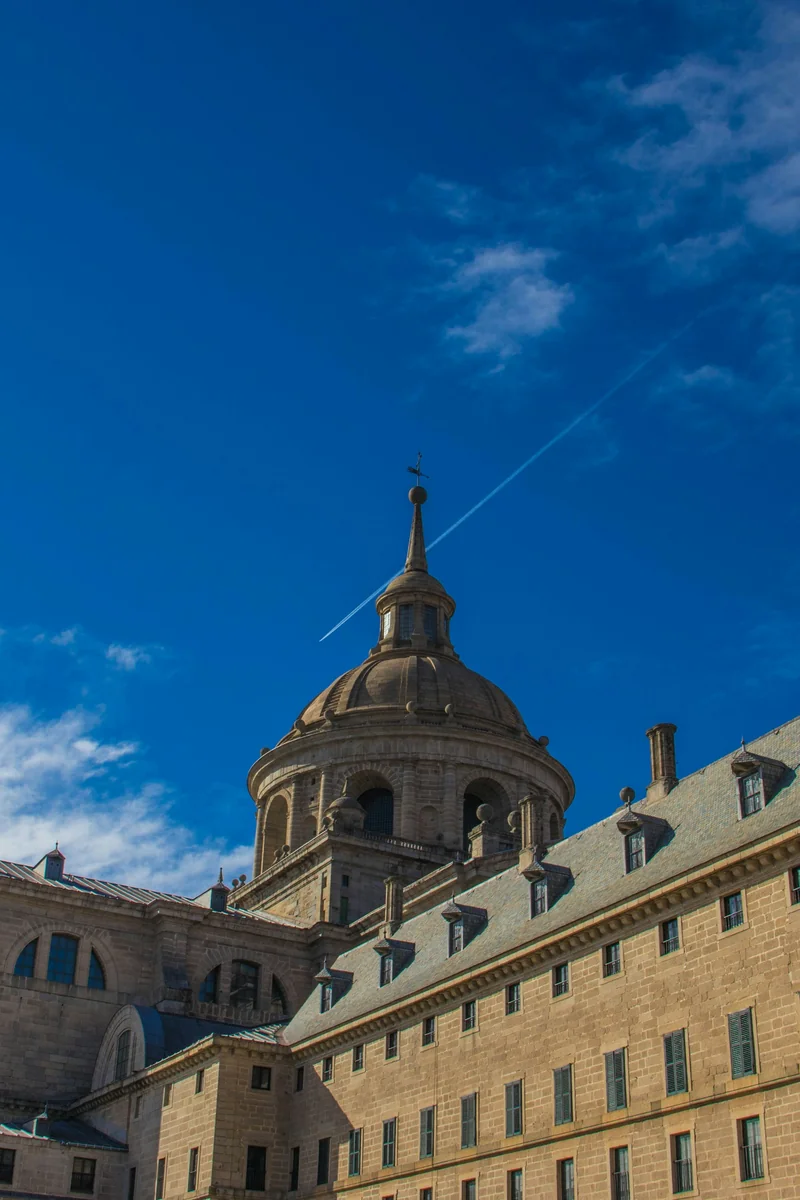
The Royal Monastery of San Lorenzo de El Escorial was begun in 1563 on the orders of Philip II of Spain and substantially complete by 1584 — barely twenty-one years for what is still the largest Renaissance building in the world. Philip II had vowed to build it after his army's victory at the Battle of Saint-Quentin in northern France on 10 August 1557, the feast day of Saint Lawrence. Saint Lawrence had been martyred on a gridiron; the monastery's celebrated grid-iron floor plan — four corner towers, long rectilinear courts, the Patio of Kings at its centre — is the architectural commemoration of that vow.
The chief architect, Juan Bautista de Toledo, drew the initial plans on Italian Renaissance principles before his death in 1567. Juan de Herrera then took over and gave the building its severe, unornamented granite finish: long horizontal cornices, plain pilasters, slate roofs that recall the Habsburg north, and an almost complete absence of carved decoration on the exterior. The style became known as estilo herreriano (the Herrerian style) and dominated Spanish royal building for the next century. The complex is built from grey granite quarried in the Sierra de Guadarrama immediately behind the building, and it has the bare, monumental presence of a hill town rather than a palace.
Beneath the basilica's high altar lies the Royal Pantheon (Panteón de los Reyes), the burial place of almost every Spanish monarch since Charles V. The chamber is octagonal, lined floor-to-ceiling in dark marble and serpentine jasper, and holds twenty-six identical bronze-fitted black-marble sarcophagi arranged in tiers — kings on one side, queens whose sons became kings on the other. A separate Pantheon of Princes (Panteón de los Infantes), nineteenth-century in date, holds the remains of royal children and queens consort. The Pantheon was begun under Philip III and Philip IV; the final marble revetment was finished only in 1654 by Giovanni Battista Crescenzi.
The Royal Library, occupying the long upper hall above the main entrance, is one of the most important historical libraries in Europe. Philip II built it as a working scholar's library and stocked it from his own collection and from purchased and confiscated holdings; it now contains roughly 40,000 printed volumes, some 4,700 manuscripts in Arabic, Latin, Greek, Hebrew, Spanish and other languages, and significant scientific and theological collections from the Spanish Golden Age. Pellegrino Tibaldi frescoed the barrel-vaulted ceiling between 1586 and 1592 with the seven liberal arts and the Christian virtues. The hall is closed to scholarly access but the public corridor lets visitors walk the full length of the room and see the original Renaissance reading desks, the celestial and terrestrial globes, and the spine-out shelving (an unusual seventeenth-century inversion designed to preserve the gilt page-edges of the bindings).